Compound reference
Selank: structure and analysis
Explore the compounds
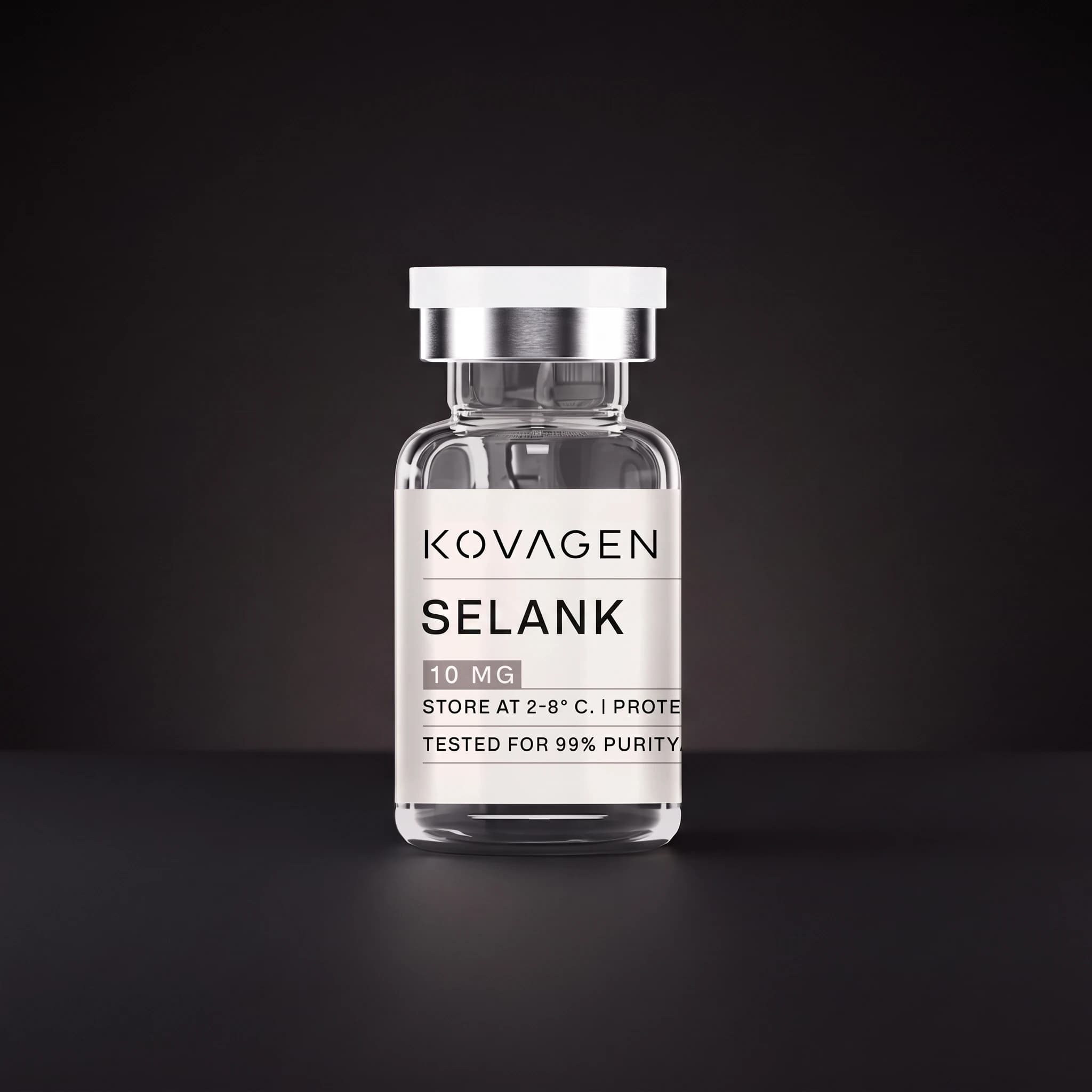
Selank is a heptapeptide analog supplied for laboratory research. Its molecular formula is C33H57N11O9, with an average molecular weight of 751.9 g/mol and a monoisotopic mass of 751.434 Da. This page covers its structure, how it is produced, and how identity and purity are established — for a batch, on that batch's certificate of analysis.
What is Selank?
Selank is a synthetic heptapeptide: a seven-residue analog of the endogenous tetrapeptide tuftsin, extended with a stabilising tripeptide tail.
The design is straightforward and worth understanding, because Semax follows the same logic. A short active sequence is joined to a proline-glycine-proline tail whose function is to slow enzymatic degradation of the parent fragment.
The result is proline-rich, which constrains the backbone conformation more than a sequence of flexible residues would.
How is Selank produced?
Assembled by solid-phase peptide synthesis: the chain is built one residue at a time on an insoluble resin support, then cleaved from the resin, deprotected and purified — most commonly by reversed-phase high-performance liquid chromatography. The purified material is lyophilized to a dry solid.
The impurity profile that appears on a certificate is a record of where that process was imperfect: deletion sequences from an incomplete coupling, truncated chains, and species retaining a protecting group.
What are the molecular figures for Selank?
Calculated from the formula C33H57N11O9, not measured. The average molecular weight counts the natural abundance of each element's isotopes; the monoisotopic mass is the mass of the single most abundant isotopic composition, which is the figure a mass spectrometer is usually compared against.
The expected ions follow from the monoisotopic mass by adding one proton per charge. They are a starting point for recognising a spectrum, not a substitute for one: adducts, salts, modifications and multiply charged species all move the observed m/z, and the certificate reports what was actually measured for a batch.
Adducts, salts, modifications and multiply charged species all move an observed m/z away from any figure calculated here, and a certificate reports what was measured for a batch rather than what was expected of it.
What is the sequence of Selank?
Selank is 7 residues long. Written in the one-letter amino-acid code, as the cited record states it:
The sequence is what an identity test resolves. The mass a spectrometer is compared against is the mass this chain implies, which is why a single missing or substituted residue changes the result by an amount that cannot be mistaken for instrument variation — the deletion is detectable rather than invisible.
Sequence information describes the molecule, not the material in a vial. What establishes a specific batch is the identity method and result on its certificate.
How does Selank compare with related compounds?
Related compounds are not interchangeable. Published figures differ between them, and in this catalogue three compounds share a GHRH backbone while several share the same structural class — which is exactly why identity is confirmed analytically rather than inferred from the label.
How is the identity of Selank confirmed?
Mass spectrometry confirms the full seven-residue chain including the tripeptide extension. A species consisting of the tuftsin fragment alone — the extension absent or cleaved — has a substantially lower mass and is an unambiguous impurity.
Which impurities can appear in Selank?
The sequence contains no methionine, cysteine or tryptophan, which means the oxidation and photodegradation pathways that dominate for Semax, MOTS-c and Kisspeptin-10 are not the principal concerns here. This is a genuinely more chemically robust sequence than its counterpart Semax.
Proline-rich peptides can show unusual chromatographic behaviour, including peak broadening arising from slow interconversion between cis and trans amide conformations. It is a method-development consideration rather than a purity problem.
What does a certificate of analysis for Selank report?
A certificate for a batch of this material names the batch, names the issuing laboratory, and states for each parameter both the method used and the specification the result was measured against. Identity and purity are the two core results; net peptide content states how much of the fill weight is actually peptide.
A certificate belongs to a batch, not to a product line. When a new batch is released it is tested again, and the certificate published against it is that batch's certificate — a previous batch's result is never carried forward.
Is Selank for human use?
No. This page describes structure and analysis. It makes no claim about what this compound does, and none should be inferred from it. Material is supplied for laboratory research use only: it is not a drug, food, dietary supplement, cosmetic or medical device, it is not for human or veterinary consumption, and no dosing, administration or reconstitution guidance is provided for any such use.
References
- Selank — PubChem, National Library of Medicine
- [Protective effect of selank on the model of mnestic function violation induced by pharmacological blockade of protein synthesis] — Eksp Klin Farmakol, 2013
From the catalog
Compounds referenced on this page
For laboratory research use only. Not for human or veterinary consumption.