Compound reference
IGF-1 LR3: structure and analysis
Explore the compounds
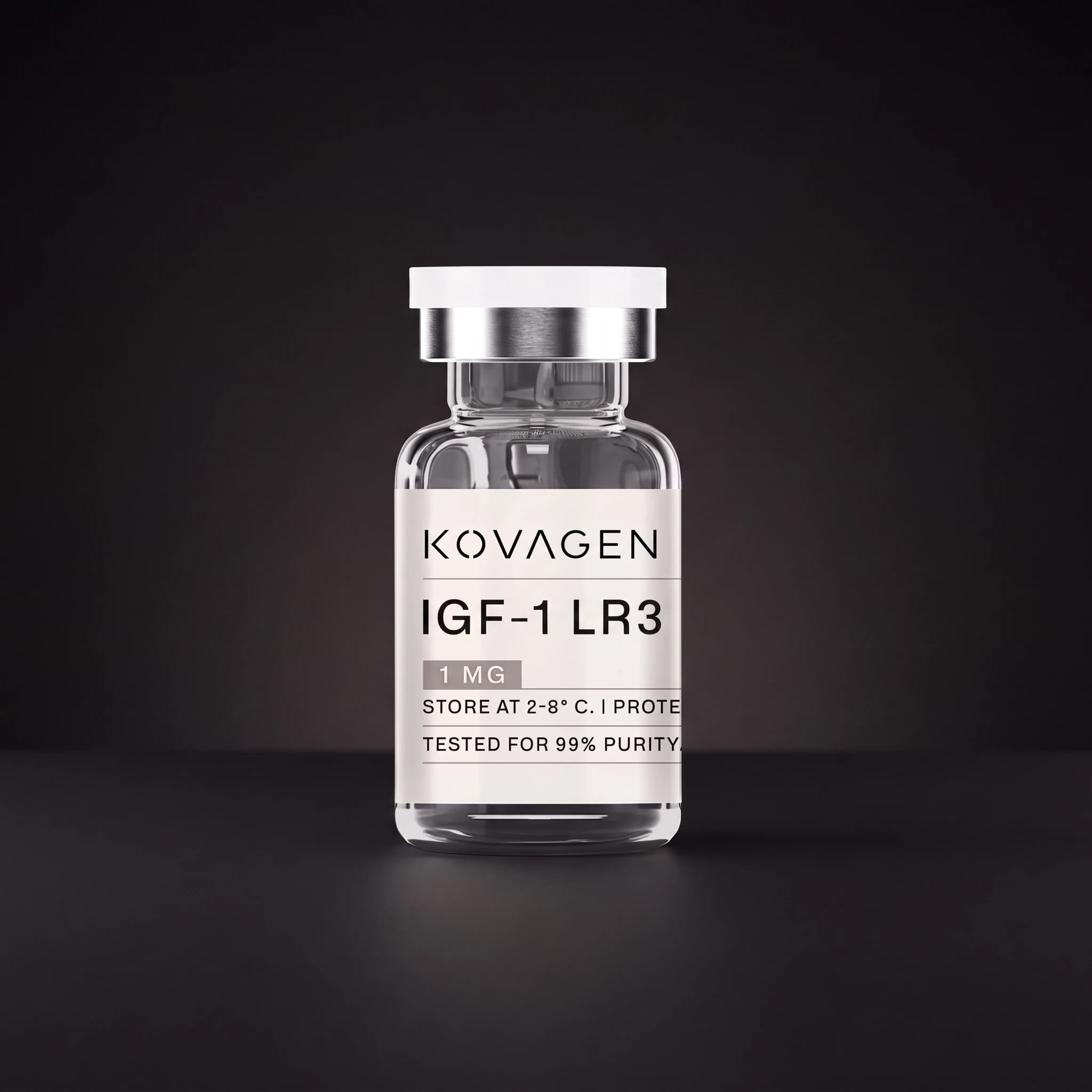
IGF-1 LR3 is an insulin-like growth factor analog supplied for laboratory research. No molecular formula is published for it on this page, because a figure that is not published is not guessed. This page covers its structure, how it is produced, and how identity and purity are established — for a batch, on that batch's certificate of analysis.
What is IGF-1 LR3?
IGF-1 LR3 is a recombinant analog of insulin-like growth factor 1, modified by a 13-amino-acid N-terminal extension and a single substitution at position 3. Native IGF-1 is a 70-residue protein, so the extended analog is a genuine protein rather than a short peptide.
That makes it the largest and structurally most complex molecule in this catalogue by a wide margin, and the only one produced recombinantly rather than by chemical synthesis.
As a protein it has a folded three-dimensional structure stabilised by internal disulfide bonds, which a short synthetic sequence does not have and cannot lose.
How is IGF-1 LR3 produced?
Produced recombinantly rather than by chemical synthesis: the sequence is expressed in a biological system, then recovered, purified and lyophilized. This is a materially different process from solid-phase synthesis, and it changes which impurities are plausible and which analytical methods are appropriate.
Aggregation and misfolding become relevant impurity classes in a way they are not for a short synthetic sequence, and residual host-derived material — including endotoxin, where expression is bacterial — becomes a parameter worth screening.
What is the molecular weight of IGF-1 LR3?
No molecular formula is published for IGF-1 LR3 on this page. A figure that is not published is not guessed: an invented mass or sequence is worse than an absent one, because it is a number a reader would have to disprove.
What establishes the material in a specific vial is the identity method and result stated on that batch's certificate, together with the laboratory that issued it.
What is the sequence of IGF-1 LR3?
No one-letter amino-acid sequence is published for IGF-1 LR3 on this page. The record this page cites describes native IGF-1, and the material supplied is the analog — an extended chain with a substitution at position 3 — so repeating the record's sequence would describe a different molecule.
What establishes the material in a specific vial is the identity method and result stated on that batch's certificate, not a notation on a reference page.
How does IGF-1 LR3 compare with related compounds?
Related compounds are not interchangeable. Published figures differ between them, and in this catalogue three compounds share a GHRH backbone while several share the same structural class — which is exactly why identity is confirmed analytically rather than inferred from the label.
How is the identity of IGF-1 LR3 confirmed?
Mass spectrometry confirms the expected mass including the N-terminal extension and the position-3 substitution. For a molecule of this size, high-resolution measurement is required to resolve the intended species from closely related variants.
Disulfide bond arrangement is part of identity for this compound in a way it is not for anything else here. A correctly sequenced protein with incorrectly paired disulfides has the same molecular mass and is not the same molecule, so mass alone is not a complete identity confirmation.
Which impurities can appear in IGF-1 LR3?
The relevant impurity classes are different from a synthetic peptide's. Aggregation — molecules associating into dimers and higher species — is a real concern for proteins and is invisible to a reversed-phase purity method designed to separate synthesis by-products. Size-exclusion chromatography reports what reversed-phase cannot see.
Because expression is biological, host-derived material is a plausible contaminant. Endotoxin screening is materially more relevant for this compound than for a synthetically assembled peptide, where there is no expression system for it to originate in.
Misfolded and partially reduced species are additional classes with no analogue in solid-phase synthesis. A certificate for a recombinant protein that reports only reversed-phase purity has not addressed the questions specific to how it was made.
What does a certificate of analysis for IGF-1 LR3 report?
A certificate for a batch of this material names the batch, names the issuing laboratory, and states for each parameter both the method used and the specification the result was measured against. Identity and purity are the two core results; net peptide content states how much of the fill weight is actually peptide.
A certificate belongs to a batch, not to a product line. When a new batch is released it is tested again, and the certificate published against it is that batch's certificate — a previous batch's result is never carried forward.
Is IGF-1 LR3 for human use?
No. This page describes structure and analysis. It makes no claim about what this compound does, and none should be inferred from it. Material is supplied for laboratory research use only: it is not a drug, food, dietary supplement, cosmetic or medical device, it is not for human or veterinary consumption, and no dosing, administration or reconstitution guidance is provided for any such use.
References
- Insulin-like growth factor 1 — human — UniProt Knowledgebase
- Mecasermin — ChEMBL, European Bioinformatics Institute
- Apoptosis in cerebellar granule cells is blocked by high KCl, forskolin, and IGF-1 through distinct mechanisms of action: the involvement of intracellular calcium and RNA synthesis — J Neurosci, 1995
From the catalog
Compounds referenced on this page
For laboratory research use only. Not for human or veterinary consumption.