Collection
Mitochondrial and mitochondria-targeting peptides
What groups these compounds
MOTS-c is a mitochondrial-derived peptide: a 16-amino-acid sequence encoded in the mitochondrial genome rather than the nuclear one, and one of a small group of such peptides identified in recent decades.
SS-31, also known as elamipretide, is not mitochondrially encoded. It is a synthetic tetrapeptide carrying an alternating aromatic-cationic motif, a structural design that causes it to concentrate at the inner mitochondrial membrane.
So the grouping is honest but the relationship is loose: one is defined by where its sequence comes from, the other by where its structure takes it.
Two different analytical problems
SS-31 contains D-amino acid residues, which makes stereochemical integrity part of its identity. A diastereomer has the same molecular mass as the intended compound, so mass spectrometry alone cannot distinguish them and chromatographic resolution carries that burden.
MOTS-c, at 16 residues, is a more conventional synthetic peptide analytically — long enough that deletion sequences are a realistic impurity class, and well suited to reversed-phase separation.
Why D-amino acids change what a certificate can prove
This is the most consequential analytical point in the collection, and it is specific to SS-31. A D-amino acid is the mirror image of the ordinary L form: same atoms, same connectivity, same molecular mass. A peptide in which one intended D residue was incorporated as the L form is therefore invisible to mass spectrometry, because nothing about the mass has changed.
Identity confirmation for this compound consequently rests on chromatography in a way it does not for the rest of the catalogue. Diastereomers can be separated under reversed-phase conditions because they interact with the stationary phase differently despite sharing a mass, but only if the method was developed to resolve them. A generic gradient plus a mass measurement — sufficient for most sequences here — cannot establish stereochemical integrity.
The reason SS-31 contains D residues at all is that they are not substrates for the proteases that cleave ordinary peptide bonds, so their presence is a deliberate structural feature rather than an artefact. That makes them part of the compound's identity, and something a certificate has to address rather than assume.
MOTS-c and the mitochondrial genome
What makes MOTS-c unusual is where its sequence is encoded. The mitochondrion carries its own small genome, separate from the nuclear one, and MOTS-c is read from an open reading frame within it — one of a small number of peptides identified this way in recent decades. Its designation as mitochondrial-derived is a statement about genomic origin, not about localisation or function.
As supplied it is a synthetic peptide like any other in the catalogue: the sequence is assembled by solid-phase synthesis rather than obtained from a biological source, so its origin is a fact about the sequence rather than about the material's production route.
At 16 residues it sits in the middle of the catalogue's size range, and it appears in Metabolic Blend alongside two components that are not peptides at all.
From the catalog
Compounds referenced on this page
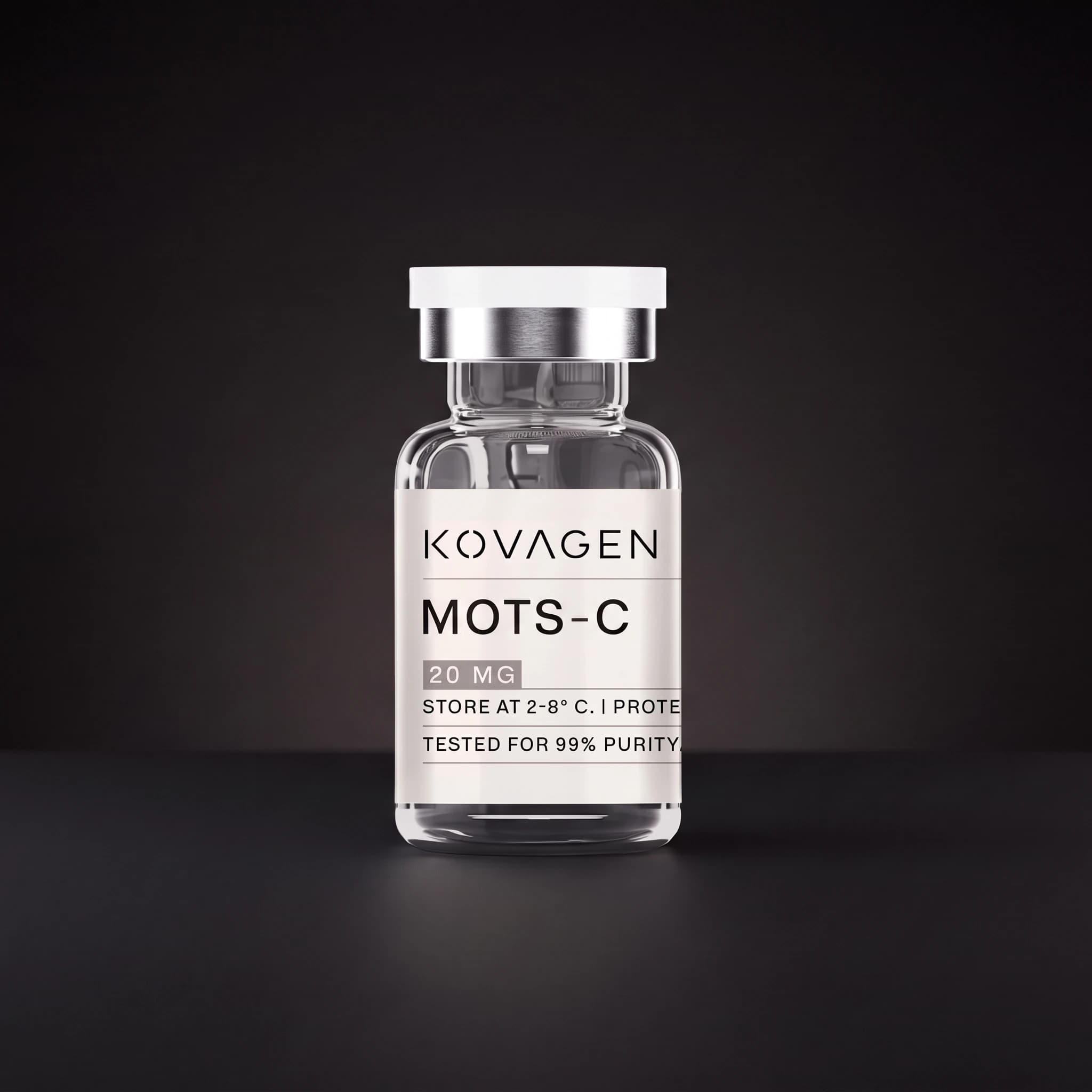


For laboratory research use only. Not for human or veterinary consumption.