Handling
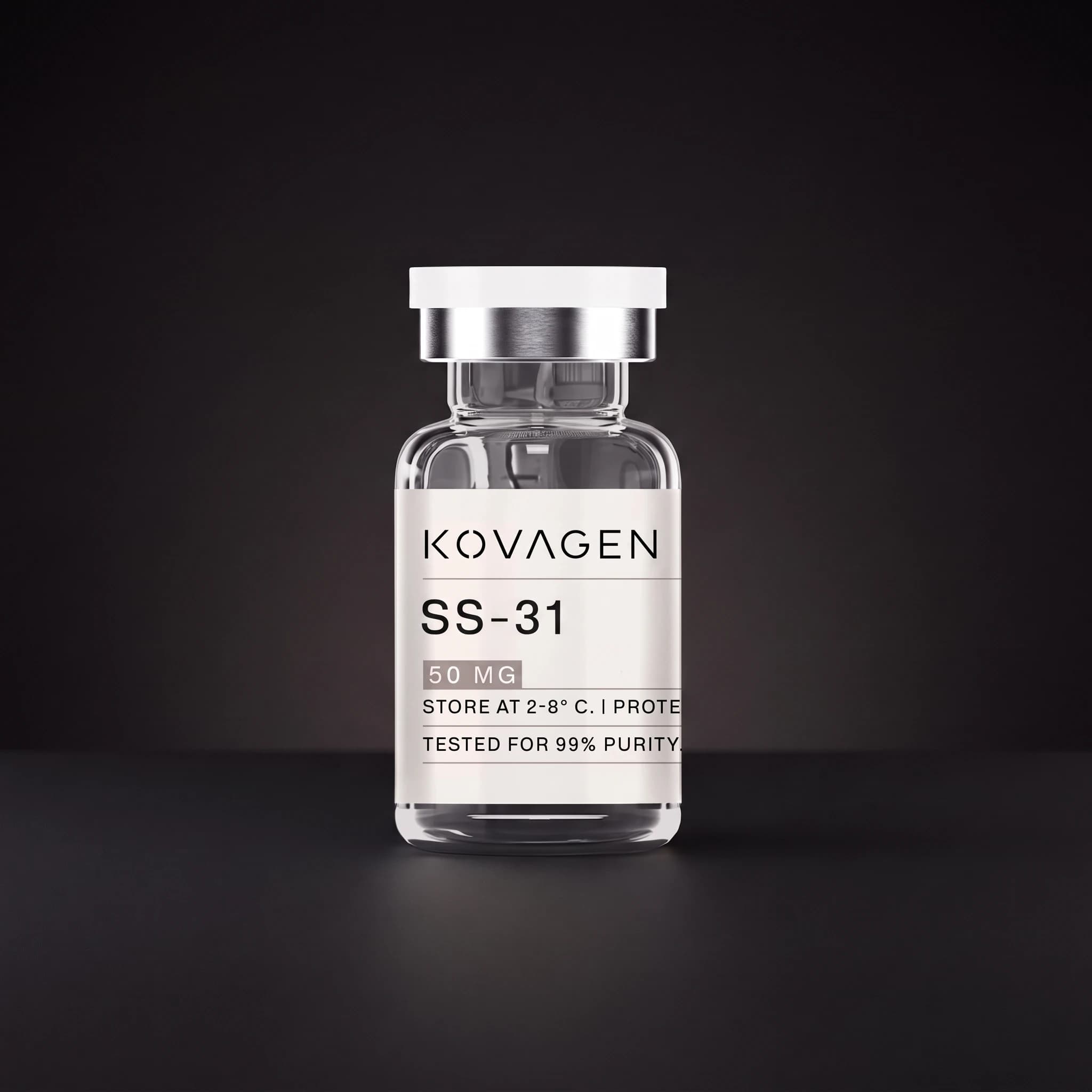
Handling and storing SS-31
SS-31 contains D-amino acids, which makes stereochemical integrity part of its identity and changes what its certificate needs to show. This page covers sealed, desiccated lyophilized powder only: how it is stored, what to inspect, and which certificate results to read. It contains no reconstitution, dosing or administration guidance for any human or animal use.
Why this compound's certificate deserves a closer read
A D-amino acid residue has exactly the same molecular mass as its L-counterpart. A diastereomer produced by incorrect stereochemistry during synthesis is therefore isobaric with the intended molecule: mass spectrometry cannot see it at all.
Detecting it is entirely a chromatographic problem, and only a method developed to resolve diastereomers will do so. This is the compound where reading the method on the certificate matters most — a high purity figure from a method that cannot separate stereoisomers has not measured the thing most worth measuring.
What D-residues do for stability
Proteases are stereospecific: they act on L-peptides and largely do not recognise D-residues as substrates. Incorporating them confers real resistance to enzymatic degradation.
That resistance is irrelevant to how a sealed vial of lyophilized powder should be stored. Enzymes are not present in a dry sealed vial; moisture, heat and light are the pathways that matter there, and stereochemistry does not defend against any of them.
A small, strongly basic molecule
At four residues with an alternating cationic motif, SS-31 is small and strongly basic. Both properties make it weakly retained on reversed-phase columns and both are reasons its analytical method is purpose-built rather than generic.
For handling, the practical consequence is the same as for any short polar peptide: keep it dry, because a hygroscopic solid of low mass takes up proportionally more water for a given exposure.
What this page does not cover
Reconstitution. We do not provide dosing, administration or reconstitution guidance for human or animal use, in any channel — that is a fixed boundary rather than an omission. Everything above concerns sealed, unopened lyophilized material, which is a question we can answer.
Handling, step by step
- Keep the vial sealed and desiccated. Leave the stopper and crimp undisturbed and the desiccant in place. Resistance to proteases is not resistance to moisture.
- Store at the temperature stated on the certificate. Conditions are stated per batch and apply to an unopened vial with an intact seal.
- Read the purity method, not just the purity figure. Confirm that the chromatographic method is capable of resolving diastereomers. For a peptide containing D-residues this is the substantive question, and mass spectrometry cannot answer it.
- Keep it in its carton. The aromatic residues in the alternating motif make light protection a sensible default.
From the catalog
Compounds referenced on this page
For laboratory research use only. Not for human or veterinary consumption.