Handling
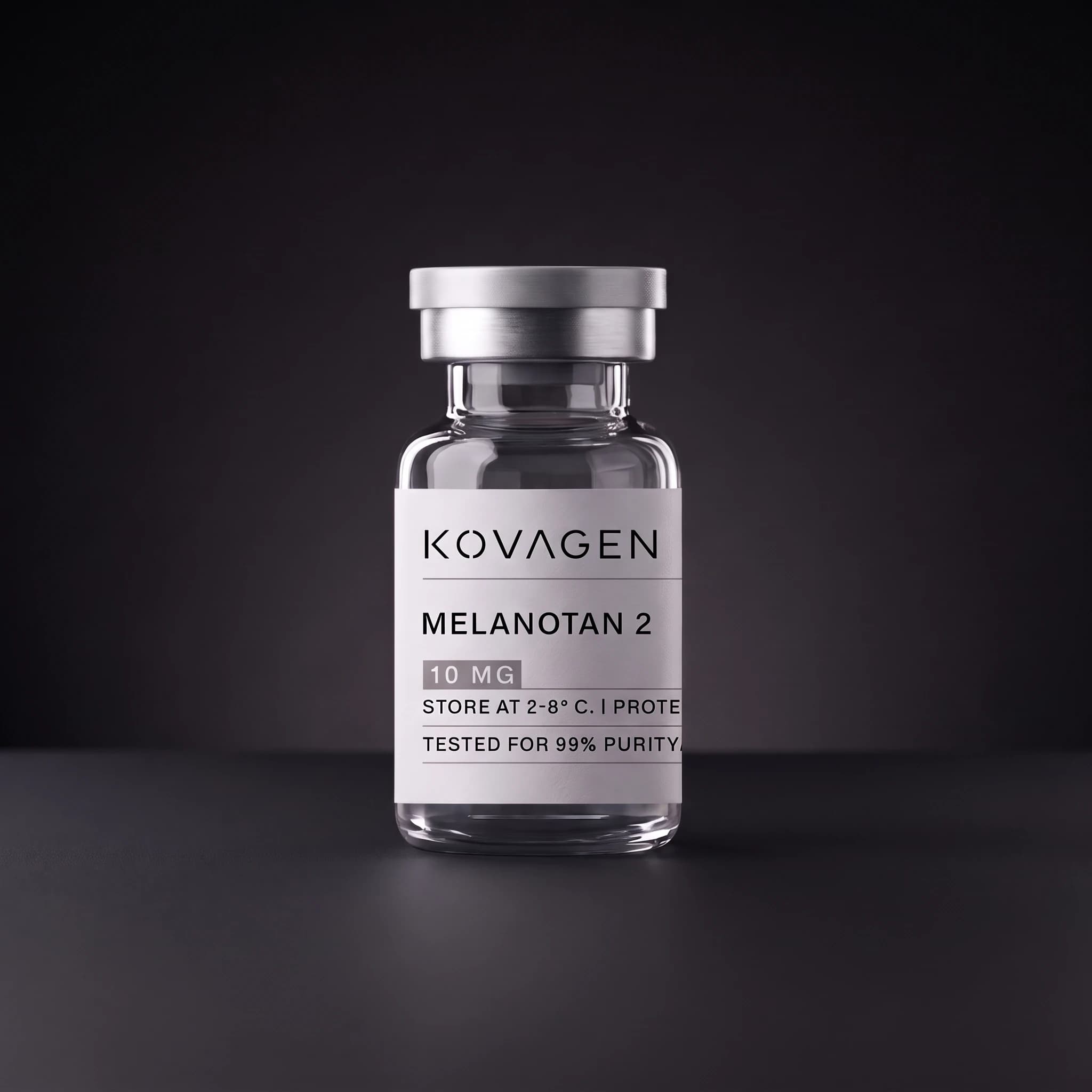
Handling and storing Melanotan II
A cyclic peptide is structurally more robust than a linear one, and the handling implications follow from that. This page covers sealed, desiccated lyophilized powder only: how it is stored, what to inspect, and which certificate results to read. It contains no reconstitution, dosing or administration guidance for any human or animal use.
Why cyclic peptides are more forgiving
The covalent bridge holding this molecule into a ring restricts backbone flexibility. Proteases need a degree of that flexibility to bind a substrate, so a cyclic peptide resists enzymatic degradation better than the equivalent linear chain.
That is a statement about the molecule's intrinsic stability, not permission to store it carelessly. The dominant threats to lyophilized material — moisture, temperature, light — act on chemistry that cyclisation does not protect against.
What to confirm on the certificate
For a cyclic peptide the identity result carries a specific burden: it should establish that cyclisation occurred. The uncyclised linear precursor has a higher mass by a predictable amount, so its absence is demonstrable rather than assumed.
This is also the compound where the relationship to PT-141 matters. The two are closely related structurally, and telling them apart depends on resolving a small mass difference — so a high-resolution identity result is more informative here than a nominal one.
Tryptophan makes light a real variable
This sequence contains tryptophan, which absorbs ultraviolet light and can degrade photochemically. That is why light protection is listed as a specific measure for this compound rather than offered as a general precaution — for a sequence with no photolabile residues it would be close to irrelevant, and here it is not.
The protection required is modest, which is the useful part. The carton the vial ships in is sufficient; the failure mode is leaving a vial out on a bench under laboratory lighting for an extended period, not brief handling in a lit room. Ordinary care with the packaging covers it.
Tryptophan photodegradation also produces species that are chemically distinct from the target, so it is the kind of change a purity method would detect on a retest. It is not a silent failure in the way protein aggregation is.
Where the fill weight goes
As with every compound here, the mass on the label is the mass of lyophilized solid rather than of peptide. For a cyclic heptapeptide carrying basic residues, purification leaves counter-ion mass behind alongside residual water, so the divergence between fill weight and net peptide content is not negligible.
The figure to work from is the net peptide content on that batch's certificate. It is reported separately for exactly this reason, and using the label weight instead will understate concentration by an amount that varies between batches.
What this page does not cover
Reconstitution. We do not provide dosing, administration or reconstitution guidance for human or animal use, in any channel — that is a fixed boundary rather than an omission. Everything above concerns sealed, unopened lyophilized material, which is a question we can answer.
Handling, step by step
- Keep the vial sealed and desiccated. Leave the stopper and crimp undisturbed and the desiccant in place. Cyclisation confers enzymatic stability, not resistance to moisture.
- Store at the temperature stated on the certificate. Conditions are stated per batch and describe an unopened vial held with its seal intact.
- Keep it in its carton. Light protection is a sensible default for any peptide containing aromatic residues.
- Confirm cyclisation on the certificate. Read the identity result specifically for confirmation that the ring closed. The linear precursor is a distinct species with a different mass.
From the catalog
Compounds referenced on this page
For laboratory research use only. Not for human or veterinary consumption.