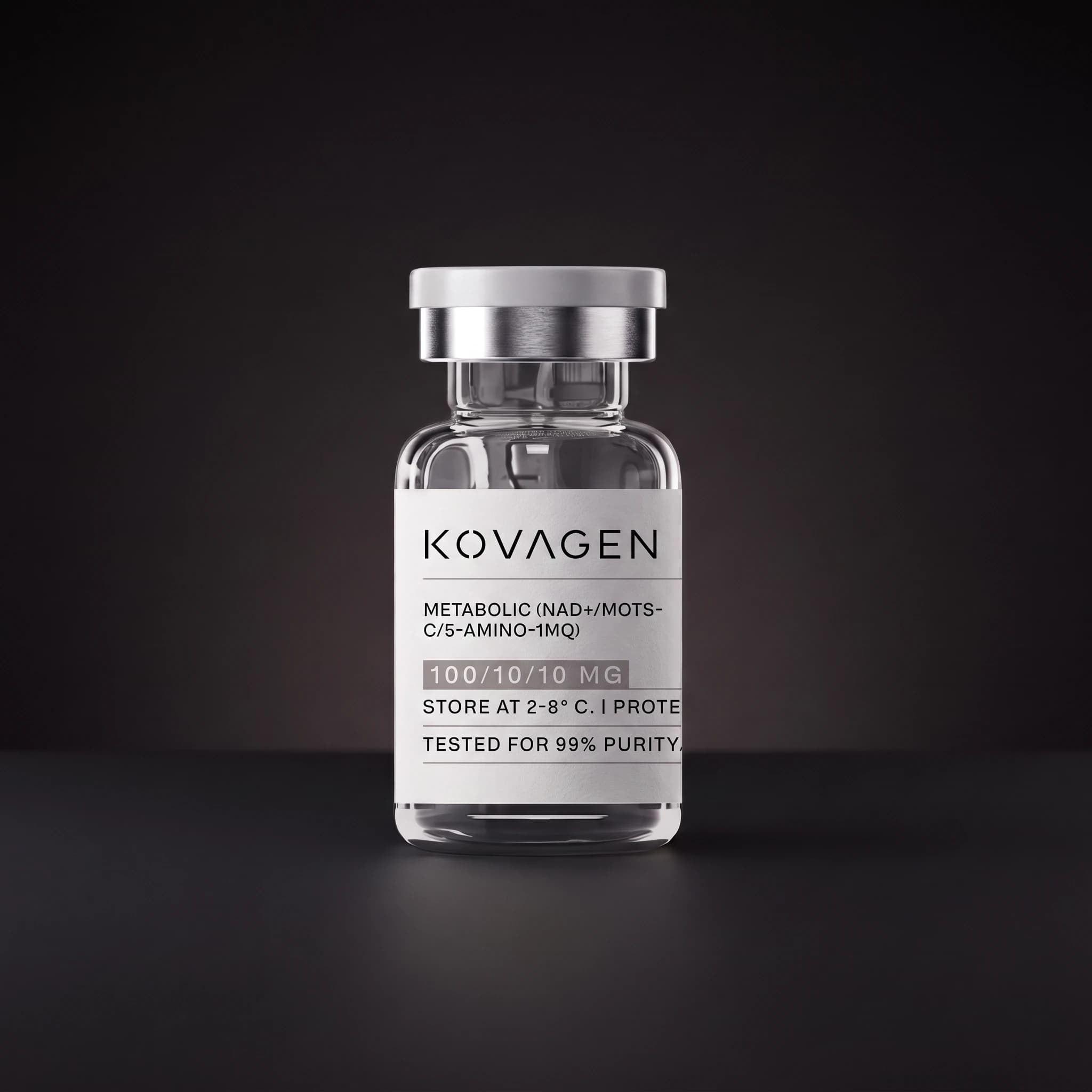
The MANTIS stack by Kovagen brings together MOTS-c, the metabolic blend, thymosin alpha-1, ipamorelin and SS-31, with BAC water included. Six components across five vials of lyophilized material.
MANTIS stands for MOTS-c, Amino-1MQ, NAD+, Thymosin alpha-1, Ipamorelin and SS-31 — six components across five vials, because the Metabolic blend carries two of them together.
MMitochondrial signaling
THE MITOCHONDRIAL-DERIVED PEPTIDE
MOTS-c
MOTS-c is a mitochondrial-derived peptide — a short sequence encoded outside the nucleus — studied for its role in metabolic regulation and cellular stress responses.
Mitochondrial signaling
Metabolic regulation
Cellular stress
MOTS-c research is predominantly preclinical. Findings in cell and animal models do not establish effects in people.
5-Amino-1MQ is a small molecule studied as an NNMT inhibitor. It is supplied in the Metabolic blend alongside NAD+ and MOTS-c, not as a standalone vial.
5-Amino-1MQ
NNMT inhibition
Preclinical
5-Amino-1MQ is not a peptide, and its evidence is preclinical. NNMT inhibition has not been shown to produce metabolic outcomes in humans.
NAD+ is a coenzyme at the centre of cellular energy metabolism and a cofactor for enzymes involved in DNA repair and cellular stress responses.
NAD+
Cofactor research
Cellular energy
NAD+ is supplied here as a research material and a component of the blend, not as a supplement. Mechanistic and preclinical work has not established clinical effects for this material.
Thymosin alpha-1 is a thymic peptide studied for its role in T-cell maturation and immune signaling.
T-cell research
Immune signaling
Thymic peptides
A pharmaceutical form of thymosin alpha-1 has been studied clinically in some countries. That work does not extend to this research vial, and immune effects for this material are not established.
SS-31 is a mitochondria-targeted tetrapeptide studied for its interaction with cardiolipin on the inner mitochondrial membrane.
Cardiolipin binding
Mitochondrial membrane
Cellular energetics
SS-31 contains D-amino acid residues, which makes stereochemical identity part of what a certificate has to establish. Chromatography, not mass alone, carries that burden. Research remains largely preclinical.
Cellular research is a broad label, and these six components sit at very different distances from human evidence. Read them separately, because they do not move together.
MOTS-c
A mitochondrial-derived peptide studied in metabolic regulation. Cell and animal models.
Preclinical
5-Amino-1MQ
A small molecule NNMT inhibitor, not a peptide. No established human outcomes.
Preclinical
NAD+
A coenzyme. Mechanistic research is extensive; clinical effects for this material are not established.
Mechanistic
Thymosin alpha-1
A pharmaceutical form has been studied clinically in some countries. These vials are not that medicine.
Studied clinically
Ipamorelin
Human pharmacology research has measured a growth-hormone response. Nothing beyond that is established.
Human pharmacology
SS-31
A mitochondria-targeted tetrapeptide. Largely preclinical; the D-amino acid content makes the analytical method matter.
Preclinical
None of these rows describes this combination. The MANTIS components have not been studied together, and evidence about one says nothing about the others.
THE BIGGER PICTURE
Beyond a single cellular process.
Your supplied collection covers four areas of cellular research, with every component listed clearly and BAC water already included.
01
Mitochondrial function
MOTS-c + SS-31
Signaling from the mitochondrion, and the membrane it is built around.
02
Cellular energy
NAD+
The coenzyme at the centre of energy metabolism.
03
Immune signaling
Thymosin alpha-1
T-cell maturation and the thymic peptide pathway.
04
GH signaling
Ipamorelin
Pulsatile growth-hormone release and the endocrine pathway behind it.
Five vials of lyophilized material — MOTS-c, the Metabolic blend, thymosin alpha-1, ipamorelin and SS-31 — plus one vial of BAC water. The Metabolic blend carries 5-Amino-1MQ, NAD+ and MOTS-c together, which is why six components arrive in five vials. Exact sizes and individual prices are shown in the stack builder.
Why do two letters point at the same vial?+
5-Amino-1MQ and NAD+ are formulated together in the Metabolic blend and cannot be separated at dispatch. The A and N pathway cards describe the two distinct components you receive in that one vial.
Can I choose my vial sizes?+
Yes. Where the catalog offers more than one size, choose your preferred option in the stack builder. The total updates immediately, and each click adds one vial of each selected product.
Is this a subscription or a premixed product?+
Neither. MANTIS is a one-time purchase of separate products, with no recurring subscription. Every vial is sealed and lyophilized, and each line stays editable in your cart.
Has the MANTIS combination been clinically tested?+
No. The combination has not been evaluated in clinical trials, and the six components sit at different stages of research — one has a pharmaceutical form studied clinically, one has human pharmacology data, and the rest are mechanistic or preclinical. None of that transfers to this stack.
Where can I find the certificates and shipping details?+
Each peptide’s product page links to its published batch certificates, and the Certificates library covers every released batch. SS-31 in particular is worth reading the certificate for, because its stereochemistry is part of the identity result. U.S. orders ship with FedEx 2Day after dispatch; shipping to Canada uses FedEx International.
MANTIS is a collection of separate research compounds. The combination itself has not been evaluated in clinical trials. 5-Amino-1MQ is a small molecule and NAD+ is a coenzyme, neither of them a peptide; both are supplied inside the Metabolic blend. MOTS-c and SS-31 research is predominantly preclinical. A pharmaceutical form of thymosin alpha-1 has been studied clinically in some countries, which does not extend to these research vials. Evidence for ipamorelin is limited to human pharmacology research on growth-hormone response.
Kovagen products are sold for laboratory research purposes only and are not intended for human or veterinary consumption. Research areas described on this page are not promised outcomes or instructions for use. Questions about use in humans or animals are not answered, in any channel, including contact@kovagen.com.