Compound reference
Cartalax: structure and analysis
Explore the compounds
Cartalax is a synthetic peptide supplied for laboratory research. No molecular formula is published for it on this page, because a figure that is not published is not guessed. This page covers its structure, how it is produced, and how identity and purity are established — for a batch, on that batch's certificate of analysis.
What is Cartalax?
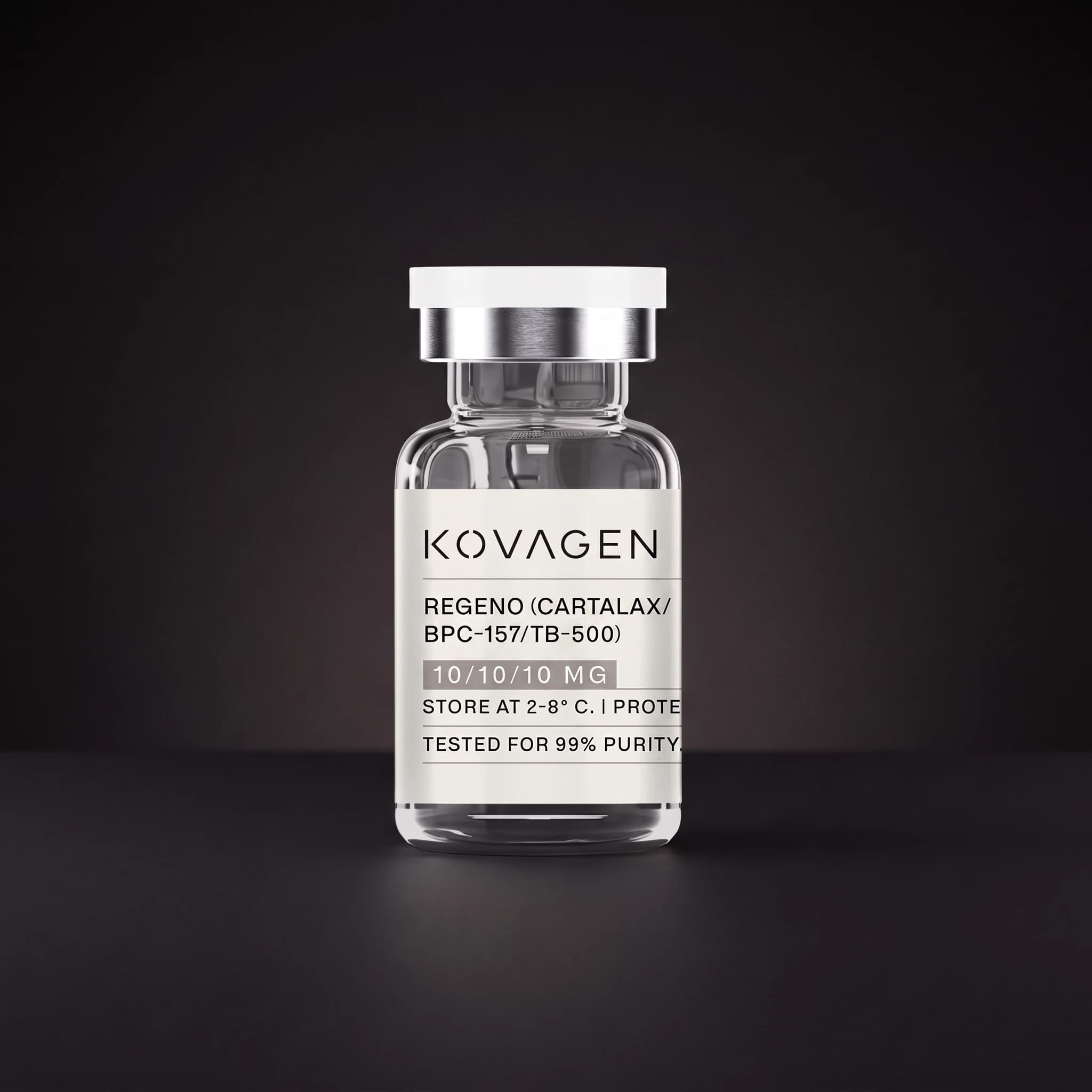
Cartalax is supplied in this catalogue as a component of the Regeno Blend, at 10 mg per vial, rather than as a standalone product. It is a synthetic peptide by every description of it we can find.
Which peptide, however, is not settled by public records. The record that carries the name lists it under more than one sequence, and the descriptions do not agree on whether it is a tripeptide or a tetrapeptide — this catalogue's own product copy calls it a tetrapeptide. Those answers cannot all be right, and a page that picked one of them would be presenting a guess as a figure.
So this page publishes no molecular formula and no mass for Cartalax. That is the same rule applied to every other compound here: a figure that is not published is not invented. What it does publish is what is actually known about the material and how a batch of it is established.
How is Cartalax produced?
Assembled by solid-phase peptide synthesis: the chain is built one residue at a time on an insoluble resin support, then cleaved from the resin, deprotected and purified — most commonly by reversed-phase high-performance liquid chromatography. The purified material is lyophilized to a dry solid.
The impurity profile that appears on a certificate is a record of where that process was imperfect: deletion sequences from an incomplete coupling, truncated chains, and species retaining a protecting group.
What is the molecular weight of Cartalax?
No molecular formula is published for Cartalax on this page. A figure that is not published is not guessed: an invented mass or sequence is worse than an absent one, because it is a number a reader would have to disprove.
What establishes the material in a specific vial is the identity method and result stated on that batch's certificate, together with the laboratory that issued it.
What is the sequence of Cartalax?
No one-letter amino-acid sequence is published for Cartalax on this page. The name does not resolve to a single published sequence, so there is no chain to write. The molecular figures above explain why this page publishes no formula for it either.
What establishes the material in a specific vial is the identity method and result stated on that batch's certificate, not a notation on a reference page.
How is the identity of Cartalax confirmed?
Identity for a batch is established against a reference standard, and the certificate states the method used and the result obtained. Where the name itself resolves to more than one proposed structure in public records, the certificate rather than the name is what establishes what a specific vial contains — which is the general argument for reading certificates made specific.
A short peptide of three or four residues is confirmed by mass spectrometry in the same way as any other: the measured mass is compared with the mass expected for the intended sequence, and a single-residue difference is a large enough mass difference to be unambiguous at this length.
Which impurities can appear in Cartalax?
At this length the expected impurity classes are the ones solid-phase synthesis always produces: deletion sequences from incomplete couplings and truncated chains from incomplete deprotection. Which of them are plausible depends on the sequence, and the sequence is the thing in question, so the identity result carries more weight here than it would for a compound whose structure is not disputed.
For the Regeno Blend as a whole, quantitation is per component: three peptides, three determinations, each against its own reference standard. A single purity figure for a three-component vial characterises the vial only if the laboratory says which component it measured.
What does a certificate of analysis for Cartalax report?
A certificate for a batch of this material names the batch, names the issuing laboratory, and states for each parameter both the method used and the specification the result was measured against. Identity and purity are the two core results; net peptide content states how much of the fill weight is actually peptide.
A certificate belongs to a batch, not to a product line. When a new batch is released it is tested again, and the certificate published against it is that batch's certificate — a previous batch's result is never carried forward.
Is Cartalax for human use?
No. This page describes structure and analysis. It makes no claim about what this compound does, and none should be inferred from it. Material is supplied for laboratory research use only: it is not a drug, food, dietary supplement, cosmetic or medical device, it is not for human or veterinary consumption, and no dosing, administration or reconstitution guidance is provided for any such use.
Common questions
Why does this page not state Cartalax's molecular weight?
Because the public records disagree about what the name refers to, and a mass follows from a sequence. If the name resolves to more than one structure, any single figure here would be a choice rather than a fact. This page publishes what is not in dispute — that it is a short synthetic peptide supplied at 10 mg per vial in the Regeno Blend — and leaves the figure to the specification the certificate is tested against.
Is Cartalax sold on its own here?
No. In this catalogue it is supplied only as a component of the Regeno Blend, at 10 mg per vial, so it has no separate size, price or certificate. The blend's product page carries the sizes and prices, and the certificate for a batch covers this component as one of its analytes.
How would a batch of Cartalax be established?
The same way any short synthetic peptide is: by comparing a measured mass against the mass expected for the intended sequence, and by quantifying the component against a reference standard, with the method stated beside the result on the certificate. Where the name itself is ambiguous, the certificate rather than the name is what establishes what is in a specific vial.
Is Cartalax for human or veterinary use?
No. It is supplied for laboratory research use only as a component of the Regeno Blend, and it is not a drug, food, dietary supplement, cosmetic or medical device. No dosing, administration or reconstitution guidance is provided for any human or animal use, in any channel.
References
- Cartalax (PubChem record; sequence listed inconsistently) — PubChem, National Library of Medicine
From the catalog
Compounds referenced on this page
For laboratory research use only. Not for human or veterinary consumption.