Guide
What is a peptide?
A peptide is a short chain of amino acids joined end to end by amide bonds, called peptide bonds. Chains of roughly two to fifty residues are usually called peptides and longer ones proteins, though the boundary is a convention rather than a sharp chemical line. A peptide is defined by its sequence: which amino acids, in which order, from the N-terminus to the C-terminus.
Amino acids joined by peptide bonds
An amino acid carries an amine group and a carboxylic acid group on the same carbon. When the carboxyl group of one amino acid reacts with the amine of the next, they form an amide bond and release one molecule of water. In a peptide that amide is called the peptide bond, and a chain built this way is a series of residues — each amino acid minus the water lost when it joined.
The chain therefore has two distinct ends: a free amine at the N-terminus and a free carboxylic acid at the C-terminus. By convention a sequence is always written from the N-terminus to the C-terminus, so GEPPPGKPADDAGLV and its reverse are different molecules.
Peptide or protein: where the line is drawn
Size is the usual dividing line. Two residues make a dipeptide, a handful an oligopeptide, and longer chains a polypeptide; a protein is a polypeptide large enough to fold into a stable three-dimensional structure, commonly taken as more than about fifty residues. The cut-off is a convention, and sources place it differently.
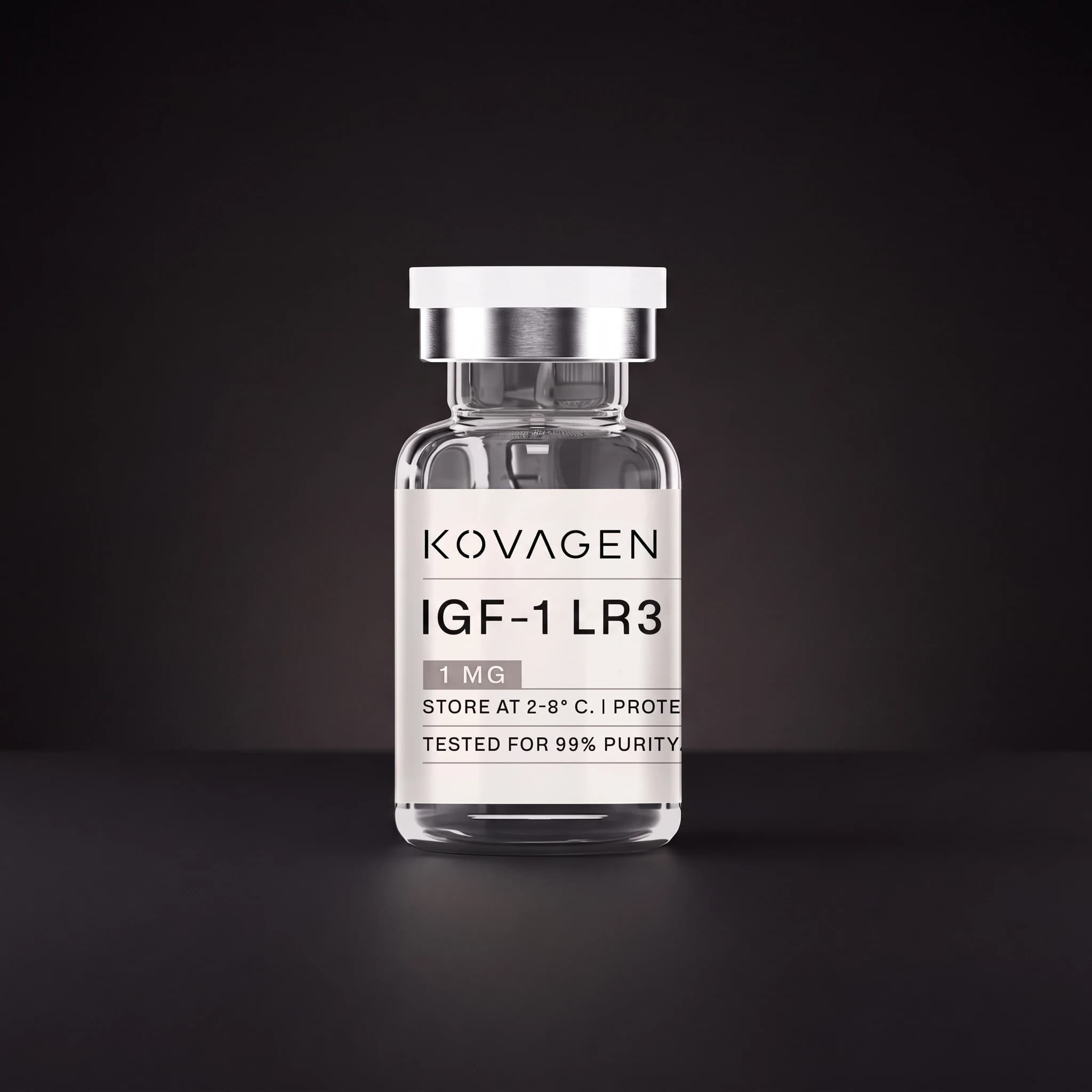
The compounds in this catalogue sit across that range. KPV has three residues, BPC-157 fifteen, thymosin alpha-1 twenty-eight and the chain of tesamorelin forty-four, while IGF-1 LR3 is a recombinant protein-sized molecule.
How a sequence is written
Each of the twenty standard amino acids has a three-letter abbreviation and a one-letter code set by IUPAC nomenclature. Three-letter notation (Gly-Glu-Pro…) is easier to read aloud; one-letter notation (GEP…) is compact and is what databases, spectrometry software and the molecular weight calculator use.
Anything that is not a standard residue — a D-amino acid, a non-natural residue, a lipid chain or a terminal cap such as an acetyl group or an amide — has to be stated separately, because the one-letter string cannot express it.
How peptides are made
- Chemical synthesis. Short and medium-length peptides are assembled by solid-phase peptide synthesis, one protected amino acid at a time on a resin, then cleaved, purified by reversed-phase HPLC and freeze-dried.
- Recombinant expression. Longer chains can be expressed in a biological system and purified, which changes which impurities are plausible.
- Isolation. Some peptides were first characterised by extraction from natural sources; research material is now almost always synthetic or recombinant.
How a peptide is characterised
Identity and purity are separate measurements. Identity is established by mass spectrometry: the observed mass must match the mass the sequence implies, and a single missing residue changes it by far more than instrument error. Purity is measured by HPLC, as the share of the chromatogram's peak area belonging to the target peptide. The amount of peptide in a vial is a third figure again, the net peptide content.
A batch certificate of analysis is where those results belong, each with its method and the laboratory that produced it.
Common questions
Is a peptide the same as a protein?
Both are chains of amino acids joined by peptide bonds. The difference is length: shorter chains are called peptides and longer, folded chains proteins, with the boundary conventionally placed at around fifty residues.
What is a peptide bond?
The amide bond formed when the carboxyl group of one amino acid reacts with the amine group of the next, releasing one molecule of water. It links every residue in the chain to its neighbour.
How many amino acids are in a peptide?
Anything from two upward. Dipeptides have two residues and oligopeptides a few; the compounds in this catalogue range from three residues to chains of more than forty.
Are research peptides natural or synthetic?
Research material is produced by chemical synthesis or recombinant expression. A peptide may correspond to a natural sequence, but the material in a vial is manufactured, and its identity is confirmed analytically rather than assumed from its name.
References
- Nomenclature and symbolism for amino acids and peptides (IUPAC-IUB JCBN recommendations 1983) — IUPAC-IUB Joint Commission on Biochemical Nomenclature, Biochemical Journal, 1984
- Advances in Fmoc solid-phase peptide synthesis — Behrendt R et al., Journal of Peptide Science, 2016
- ICH Q6B: Specifications — Test Procedures and Acceptance Criteria for Biotechnological/Biological Products — International Council for Harmonisation (ICH)
From the catalog
Compounds referenced on this page
For laboratory research use only. Not for human or veterinary consumption.