Compound reference
5-Amino-1MQ: structure and analysis
Explore the compounds
5-Amino-1MQ is a quinolinium small molecule supplied for laboratory research. Its formula is published as C10H11N2+, with an average molecular weight of 159.21 g/mol. That species is already charged, so the ion a spectrum is compared against is the molecule itself at 159.0922 m/z rather than a protonated neutral. This page covers its structure, how it is produced, and how identity and purity are established — for a batch, on that batch's certificate of analysis.
What is 5-Amino-1MQ?
5-Amino-1MQ — 5-amino-1-methylquinolinium, also written 5-amino-1-methylquinolinium ion — is a small-molecule heteroaromatic cation, not a peptide. Its formula is C10H11N2+ as the cation, with an average mass of 159.21 and a monoisotopic mass of 159.092 Da.
The positive charge sits on the ring nitrogen and is permanent: this is a quaternary ammonium, so the material is supplied as a salt with a counter-ion rather than as a neutral molecule. The catalogue writes the name 5 Amino 1MQ and 5-Amino-1MQ for the same component.
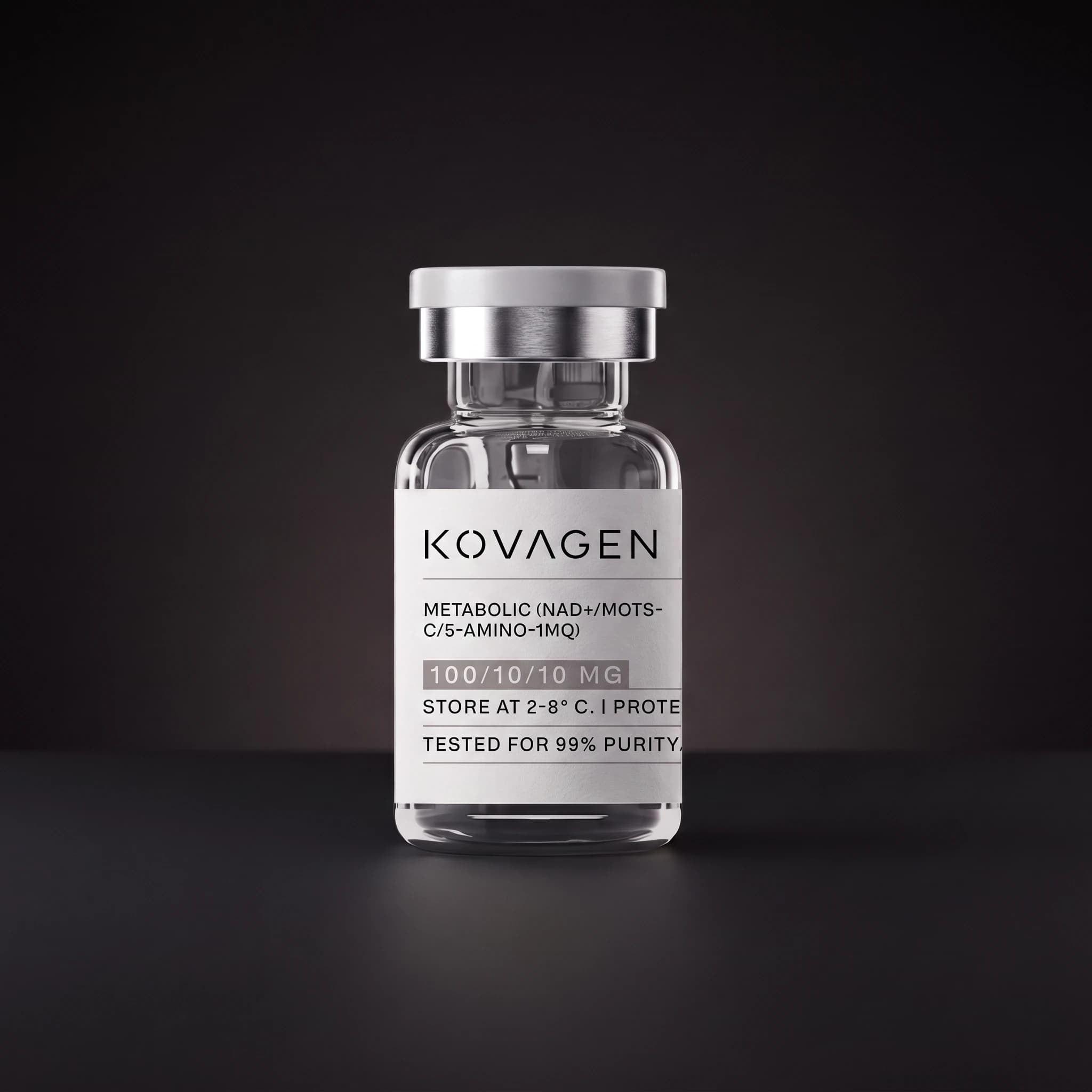
In this catalogue it is supplied as a component of the Metabolic Blend, at 10 mg per vial, rather than as a standalone product.
How is 5-Amino-1MQ produced?
Not a peptide, and not made by peptide synthesis. Small molecules of this kind are produced by chemical synthesis, or by fermentation followed by purification, depending on the molecule and the manufacturer — and the certificate for a batch states what was tested rather than what is assumed from the name.
The impurity classes that matter follow from the chemistry rather than from a synthesis template: residual solvents and reagents, related substances from the synthetic route, and the counter-ion, where the material is supplied as a salt. None of those is a deletion sequence, and a peptide impurity method does not detect them.
What are the molecular figures for 5-Amino-1MQ?
5-Amino-1MQ is published with the formula C10H11N2+. The monoisotopic mass and expected [M+H]⁺ are not stated here, because this is not a neutral single molecule: the metal ion is coordinated to the peptide and the species is itself charged, so a neutral-molecule ion has nothing to attach to.
What a mass spectrometer is compared against for a species like this is the ion itself, at the exact mass of the published formula. The identity result and the method stated on a batch certificate are what establish the material in a specific vial, and a certificate for this compound is read the same way as any other — per parameter, against a stated specification.
What is the sequence of 5-Amino-1MQ?
No one-letter amino-acid sequence is published for 5-Amino-1MQ on this page. 5-Amino-1MQ is not a peptide: it is a small-molecule quinolinium, so it has no amino-acid chain to write.
What establishes the material in a specific vial is the identity method and result stated on that batch's certificate, not a notation on a reference page.
How is the identity of 5-Amino-1MQ confirmed?
Confirmation is against a reference standard of the same cation. The aromatic ring gives it strong ultraviolet absorbance and a retention behaviour quite unlike a peptide's, so a method built for peptides neither separates it appropriately nor detects it appropriately.
Because the species is already charged, a mass-spectrometric confirmation is looking at the cation itself rather than at a protonated neutral molecule: the expected ion is at m/z 159.09, and a reported value has to be read against the polarity and the instrument's calibration. The counter-ion is a separate question, and a certificate that identifies only the cation leaves the salt form unstated.
Which impurities can appear in 5-Amino-1MQ?
The impurity profile follows from the synthetic route that made the ring rather than from a peptide coupling cycle: related aromatic substances, residual reagents and solvents. None of those is a deletion sequence, and a peptide impurity method does not see them.
As with any charged aromatic small molecule, purity measured as a share of total peak area at one wavelength is only as meaningful as the method behind it — which is why the certificate states the method next to the result rather than a bare percentage.
What does a certificate of analysis for 5-Amino-1MQ report?
A certificate for a batch of this material names the batch, names the issuing laboratory, and states for each parameter both the method used and the specification the result was measured against. Identity and purity are the two core results; net peptide content states how much of the fill weight is actually peptide.
A certificate belongs to a batch, not to a product line. When a new batch is released it is tested again, and the certificate published against it is that batch's certificate — a previous batch's result is never carried forward.
Is 5-Amino-1MQ for human use?
No. This page describes structure and analysis. It makes no claim about what this compound does, and none should be inferred from it. Material is supplied for laboratory research use only: it is not a drug, food, dietary supplement, cosmetic or medical device, it is not for human or veterinary consumption, and no dosing, administration or reconstitution guidance is provided for any such use.
Common questions
Is 5-Amino-1MQ a peptide?
No. It is a small-molecule heteroaromatic cation — 5-amino-1-methylquinolinium — and it is not assembled from amino acids, so peptide synthesis, peptide impurity classes and peptide purity methods do not describe it. In the Metabolic Blend it is one of two components that are not peptides.
Why does its formula carry a plus sign?
Because the positive charge is structural rather than conditional: the nitrogen in the ring is quaternary, so the cation is the molecule rather than a state it enters at a particular pH. The material is therefore supplied as a salt with a counter-ion, and a certificate that identifies the cation establishes the main species rather than the whole salt.
What ion would a mass spectrometer see?
The cation itself, at m/z 159.09. Because the species is already charged, there is no neutral molecule to protonate, so the usual [M+H]⁺ arithmetic does not apply — an observation has to be read against the polarity and calibration the laboratory used, both of which the certificate states.
Is 5-Amino-1MQ for human or veterinary use?
No. It is supplied for laboratory research use only as a component of the Metabolic Blend, and it is not a drug, food, dietary supplement, cosmetic or medical device. No dosing, administration or reconstitution guidance is provided for any human or animal use, in any channel.
References
- 5-Amino-1-methylquinolinium — PubChem, National Library of Medicine
From the catalog
Compounds referenced on this page
In stock
Metabolic
Metabolic (NAD+ / MOTS-c / 5 Amino 1MQ) 100/10/10
100/10/10mg
For laboratory research use only. Not for human or veterinary consumption.