Compound reference
Cagrilintide: structure and analysis
Explore the compounds
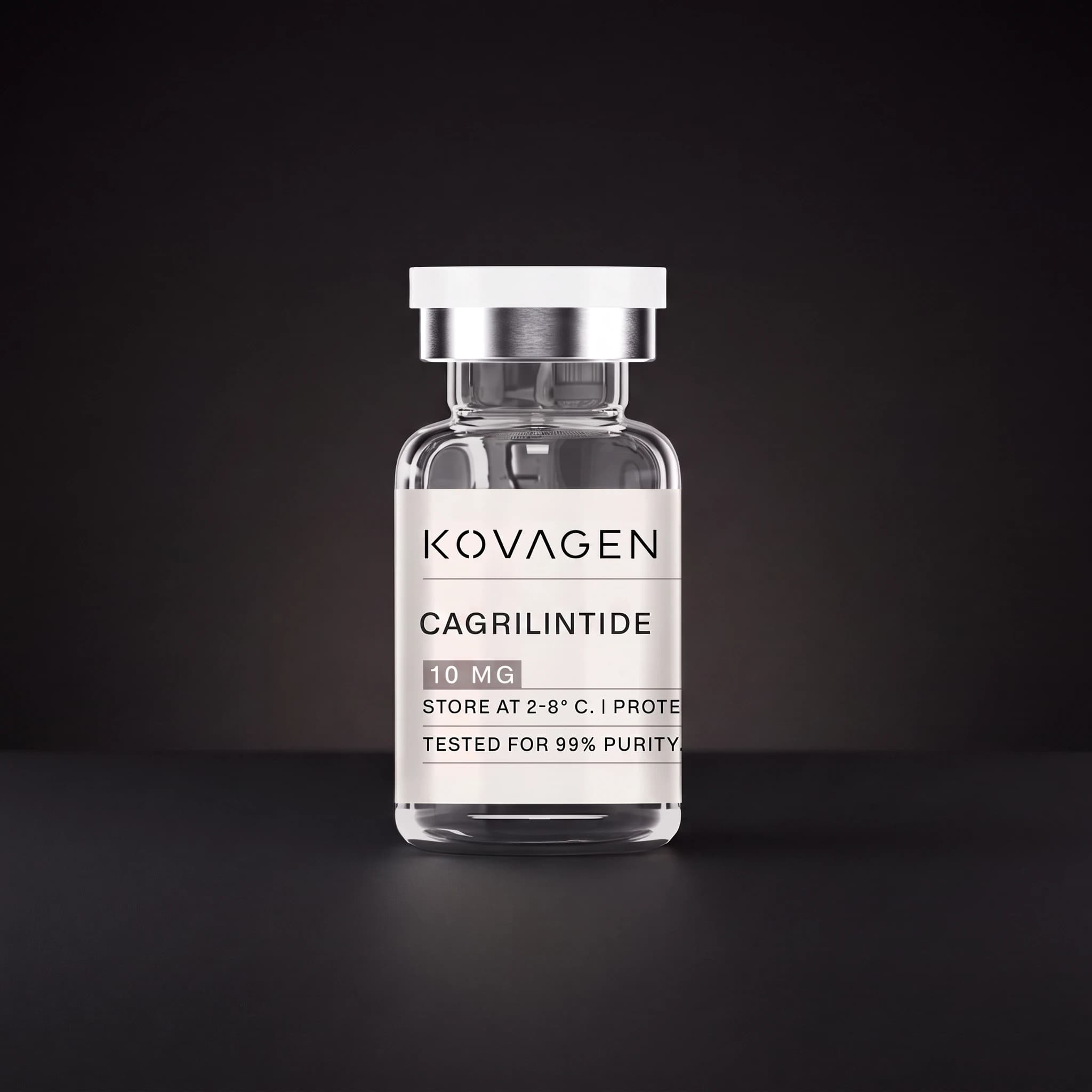
Cagrilintide is an amylin analog research candidate supplied for laboratory research. Its molecular formula is C194H312N54O59S2, with an average molecular weight of 4409 g/mol and a monoisotopic mass of 4406.252 Da. This page covers its structure, how it is produced, and how identity and purity are established — for a batch, on that batch's certificate of analysis.
What is Cagrilintide?
Cagrilintide is a synthetic long-acting analog of amylin, a pancreatic peptide hormone. It is a clinical-stage investigational compound and is not an approved medicine in any jurisdiction.
The catalogue lists this compound as Cagrilintide. The certificate issued against each batch specifies the material and the analytical methods used.
How is Cagrilintide produced?
Produced synthetically and supplied lyophilized. This is a clinical-stage investigational compound and is not an approved medicine in any jurisdiction.
The catalogue uses the compound name. Refer to the certificate for the specific batch for its analytical results, methods and specifications.
What are the molecular figures for Cagrilintide?
Calculated from the formula C194H312N54O59S2, not measured. The average molecular weight counts the natural abundance of each element's isotopes; the monoisotopic mass is the mass of the single most abundant isotopic composition, which is the figure a mass spectrometer is usually compared against.
Two masses describe this molecule and they are not the same number. The monoisotopic mass assumes every carbon is carbon-12; the tallest peak in the isotope envelope sits 2 carbon-13 substitutions above it, because for a molecule with 194 carbons that is the most probable composition. A specification or a database quoting the higher figure is not necessarily wrong — it is quoting the other peak, and both are given here.
Adducts, salts, modifications and multiply charged species all move an observed m/z away from any figure calculated here, and a certificate reports what was measured for a batch rather than what was expected of it.
What is the sequence of Cagrilintide?
No one-letter amino-acid sequence is published for Cagrilintide on this page. The analog carries non-natural residues and a covalent modification, so a one-letter string would not describe the molecule as supplied.
What establishes the material in a specific vial is the identity method and result stated on that batch's certificate, not a notation on a reference page.
How is the identity of Cagrilintide confirmed?
Mass spectrometry can compare the measured mass with the expected mass for the compound. The actual method used for a supplied batch is stated in its certificate. For an analog carrying a long-acting modification, that modification is itself part of what the identity confirmation establishes.
Which impurities can appear in Cagrilintide?
Analog peptides of this class carry structural modifications intended to extend circulating half-life, and those modifications are the features an identity method has to resolve — a partially modified species has a different mass from the intended compound and is a distinct impurity rather than a variation.
Because the compound is investigational rather than approved, there is no pharmacopoeial monograph to test against. The specification on its certificate is the reference.
What does a certificate of analysis for Cagrilintide report?
A certificate for a batch of this material names the batch, names the issuing laboratory, and states for each parameter both the method used and the specification the result was measured against. Identity and purity are the two core results; net peptide content states how much of the fill weight is actually peptide.
A certificate belongs to a batch, not to a product line. When a new batch is released it is tested again, and the certificate published against it is that batch's certificate — a previous batch's result is never carried forward.
Is Cagrilintide for human use?
No. This page describes structure and analysis. It makes no claim about what this compound does, and none should be inferred from it. Material is supplied for laboratory research use only: it is not a drug, food, dietary supplement, cosmetic or medical device, it is not for human or veterinary consumption, and no dosing, administration or reconstitution guidance is provided for any such use.
References
- Cagrilintide — PubChem, National Library of Medicine
- Islet amyloid polypeptide (amylin) — human — UniProt Knowledgebase
- Development of Cagrilintide, a Long-Acting Amylin Analogue — PubMed, 2021
From the catalog
Compounds referenced on this page
For laboratory research use only. Not for human or veterinary consumption.