Compound reference
Tesamorelin / Ipamorelin: structure and analysis
Explore the compounds
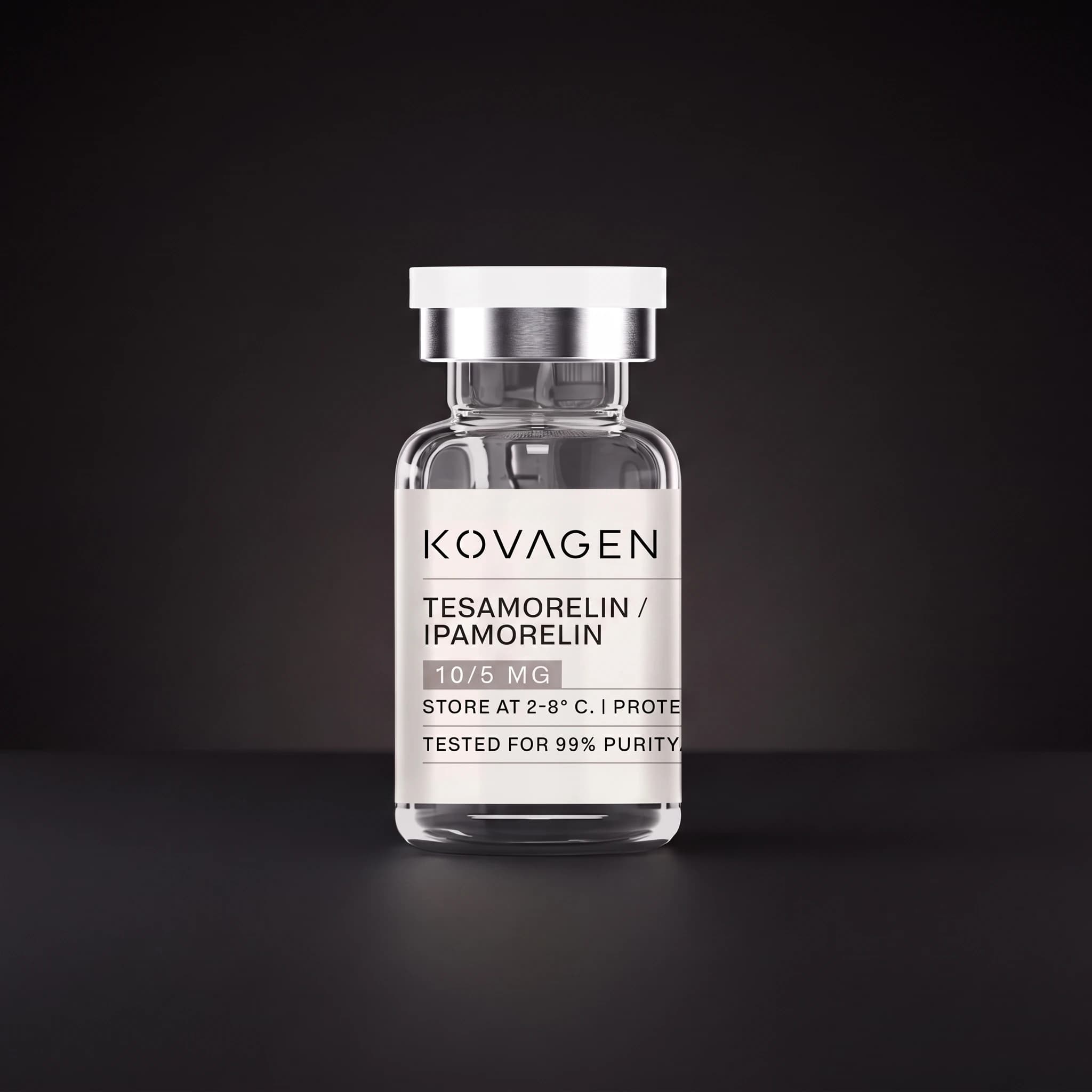
Tesamorelin / Ipamorelin is a two-compound research blend supplied for laboratory research. Each vial contains Tesamorelin at 10 mg and Ipamorelin at 5 mg, combined and co-lyophilized into one vial, so it has no single molecular formula. This page covers its structure, how it is produced, and how identity and purity are established — for a batch, on that batch's certificate of analysis.
What is Tesamorelin / Ipamorelin?
A two-compound blend supplied in a single vial: Tesamorelin at 10 mg and Ipamorelin at 5 mg. The notation 10/5mg states each component's mass in that order — unlike most blends here, the components are not at equal mass.
Tesamorelin is a 44-residue analog of the full growth hormone-releasing hormone sequence, N-terminally modified with a trans-3-hexenoyl group. Ipamorelin is a synthetic pentapeptide containing the non-natural residue 2-aminoisobutyric acid.
Forty-four residues alongside five is the widest size ratio of any two-component blend in the catalogue.
How is Tesamorelin / Ipamorelin produced?
Supplied as a blend: the named components are combined and co-lyophilized into a single vial, with the mass of each component stated. The components are produced separately and characterised before combination.
This changes the analytical question. For a single compound, purity asks what share of the detected material was the target. For a blend there are several targets, and what matters is whether each named component is present at its stated mass — per-component identification and quantitation rather than one purity percentage.
What is in Tesamorelin / Ipamorelin?
Tesamorelin / Ipamorelin is supplied as one co-lyophilized vial holding 2 separately characterised components, in the ratio 10/5mg. A blend has no single molecular formula, because a formula describes one molecule and this vial holds several, so the table gives each component's own published figures.
For a neutral molecule the ion a mass spectrometer is compared against is the protonated species, [M+H]⁺. Two of these components are already charged — a copper complex and a quaternary ammonium — and for those the ion to compare against is the species itself; the table says which is which.
Two masses describe each of these molecules and they are different numbers: the monoisotopic mass, which assumes every carbon is carbon-12, and the tallest peak in the isotope envelope, which for a long peptide sits one or two carbon-13 substitutions above it. The table gives the monoisotopic figure; each component's own page gives both.
What a certificate can establish for a vial like this is a separate identity and a separate quantitation for each named component, each against a standard appropriate to that molecule. One purity percentage does not describe several targets, and the certificate has to be read per analyte rather than as one number.
How does Tesamorelin / Ipamorelin compare with related compounds?
Related compounds are not interchangeable. Published figures differ between them, and in this catalogue three compounds share a GHRH backbone while several share the same structural class — which is exactly why identity is confirmed analytically rather than inferred from the label.
How is the identity of Tesamorelin / Ipamorelin confirmed?
Both components require independent confirmation. For Tesamorelin that includes confirming the N-terminal acyl modification as well as the 44-residue chain; for Ipamorelin it includes the non-natural residue.
The very large size difference makes distinguishing the two components trivially unambiguous, which is the easiest part of characterising this vial.
Which impurities can appear in Tesamorelin / Ipamorelin?
The unequal component masses matter for quantitation: a result has to establish 10 mg of one component and 5 mg of the other, so a method that simply confirms both are present has not verified the composition.
The wide size range means one gradient must properly retain a pentapeptide and adequately resolve a 44-residue peptide from its numerous deletion products. Those are conflicting requirements, and the method is necessarily a considered compromise.
Storage conditions are set by the least stable component in the vial.
What does a certificate of analysis for Tesamorelin / Ipamorelin report?
A certificate for a batch of this material names the batch, names the issuing laboratory, and states for each parameter both the method used and the specification the result was measured against. Identity and purity are the two core results; net peptide content states how much of the fill weight is actually peptide.
A certificate belongs to a batch, not to a product line. When a new batch is released it is tested again, and the certificate published against it is that batch's certificate — a previous batch's result is never carried forward.
Is Tesamorelin / Ipamorelin for human use?
No. This page describes structure and analysis. It makes no claim about what this compound does, and none should be inferred from it. Material is supplied for laboratory research use only: it is not a drug, food, dietary supplement, cosmetic or medical device, it is not for human or veterinary consumption, and no dosing, administration or reconstitution guidance is provided for any such use.
Common questions
What is in Tesamorelin / Ipamorelin?
One vial contains Tesamorelin at 10 mg and Ipamorelin at 5 mg. The ratio 10/5mg on the product states each named component's mass in that order, and the components are combined and dried together in that one vial rather than supplied as separate vials.
Does Tesamorelin / Ipamorelin have a single purity figure?
No. Purity in the peptide sense describes one target measured against its own impurities, and this vial has 2 targets. Each component's purity is meaningful only against its own reference standard, so a certificate for this blend reports per-component results rather than one percentage for the vial.
Is Tesamorelin / Ipamorelin supplied pre-mixed?
It is supplied as a single sealed vial of co-lyophilized powder: the named components are combined before drying, and nothing is supplied as a liquid or reconstituted before dispatch. Each component's mass is stated in the ratio on the product page and on its batch certificate.
How is each component of Tesamorelin / Ipamorelin established?
Each named component is identified and quantified against its own reference standard, with the method stated beside the result. Read the certificate per analyte rather than as one number: one row per component, a stated method, and a result measured against a stated specification. A certificate that reports a single purity figure for a vial like this has characterised one component and implied it characterised all of them.
Is Tesamorelin / Ipamorelin for human or veterinary use?
No. It is supplied for laboratory research use only, and it is not a drug, food, dietary supplement, cosmetic or medical device. No dosing, administration or reconstitution guidance is provided for any human or animal use, in any channel.
References
- Tesamorelin — PubChem, National Library of Medicine
- Somatoliberin (GHRH) — human — UniProt Knowledgebase
- Ipamorelin — PubChem, National Library of Medicine
- Ipamorelin — ChEBI, European Bioinformatics Institute
From the catalog
Compounds referenced on this page
For laboratory research use only. Not for human or veterinary consumption.