Compound reference
SNAP-8: structure and analysis
Explore the compounds
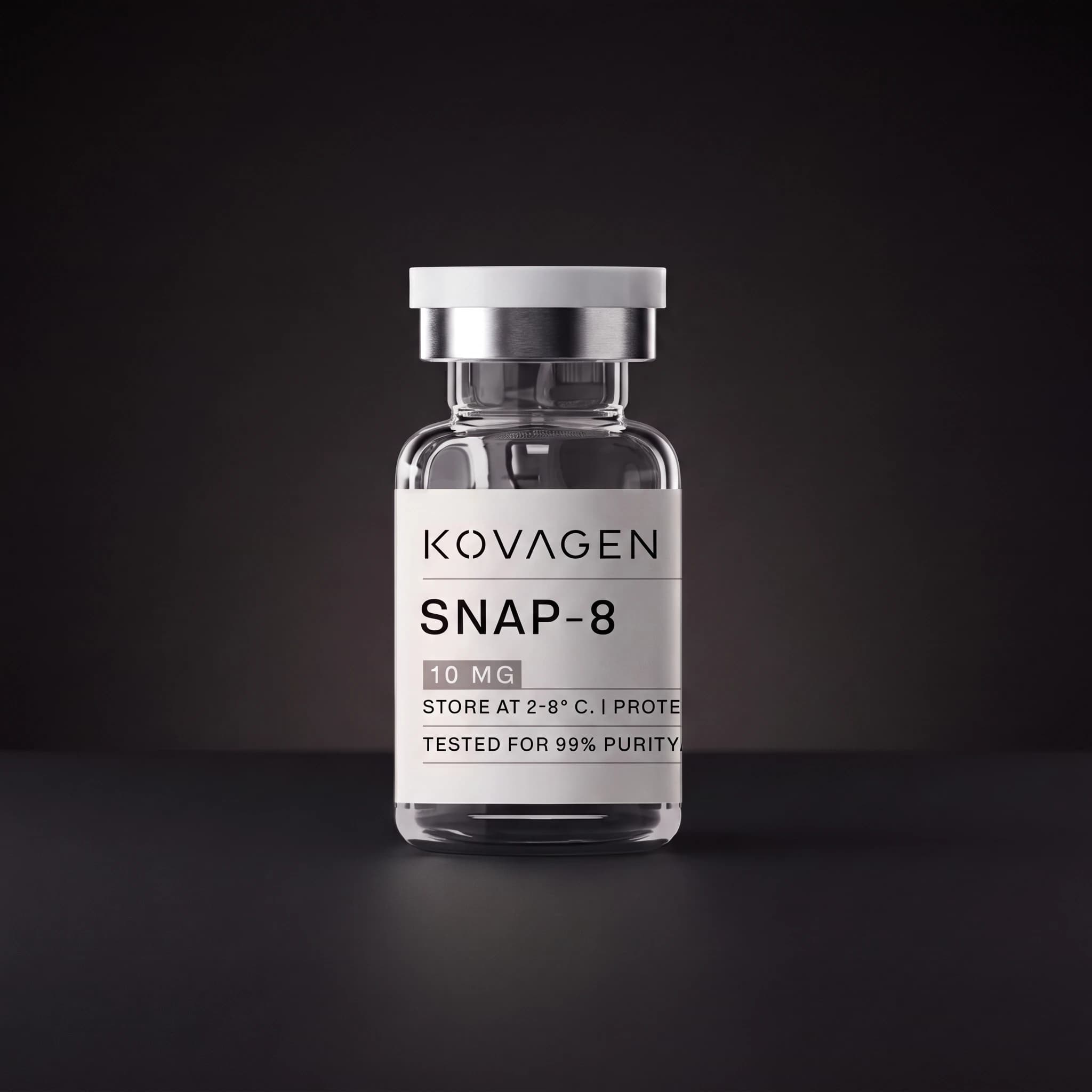
SNAP-8 is an acetyl octapeptide-3 supplied for laboratory research. Its molecular formula is C41H70N16O16S, with an average molecular weight of 1075.2 g/mol and a monoisotopic mass of 1074.488 Da. This page covers its structure, how it is produced, and how identity and purity are established — for a batch, on that batch's certificate of analysis.
What is SNAP-8?
SNAP-8 is acetyl octapeptide-3: an eight-residue sequence extended from the hexapeptide argireline, carrying an acetyl group on its N-terminus.
Two structural features define it. The extension from six residues to eight, and the N-terminal acetylation — a small chemical modification that caps the free amine at the start of the chain.
How is SNAP-8 produced?
Assembled by solid-phase peptide synthesis: the chain is built one residue at a time on an insoluble resin support, then cleaved from the resin, deprotected and purified — most commonly by reversed-phase high-performance liquid chromatography. The purified material is lyophilized to a dry solid.
The impurity profile that appears on a certificate is a record of where that process was imperfect: deletion sequences from an incomplete coupling, truncated chains, and species retaining a protecting group.
What are the molecular figures for SNAP-8?
Calculated from the formula C41H70N16O16S, not measured. The average molecular weight counts the natural abundance of each element's isotopes; the monoisotopic mass is the mass of the single most abundant isotopic composition, which is the figure a mass spectrometer is usually compared against.
The expected ions follow from the monoisotopic mass by adding one proton per charge. They are a starting point for recognising a spectrum, not a substitute for one: adducts, salts, modifications and multiply charged species all move the observed m/z, and the certificate reports what was actually measured for a batch.
Adducts, salts, modifications and multiply charged species all move an observed m/z away from any figure calculated here, and a certificate reports what was measured for a batch rather than what was expected of it.
What is the sequence of SNAP-8?
SNAP-8 is 8 residues long. Written in the one-letter amino-acid code, as the cited record states it:
The sequence is what an identity test resolves. The mass a spectrometer is compared against is the mass this chain implies, which is why a single missing or substituted residue changes the result by an amount that cannot be mistaken for instrument variation — the deletion is detectable rather than invisible.
Sequence information describes the molecule, not the material in a vial. What establishes a specific batch is the identity method and result on its certificate.
How does SNAP-8 compare with related compounds?
Related compounds are not interchangeable. Published figures differ between them, and in this catalogue three compounds share a GHRH backbone while several share the same structural class — which is exactly why identity is confirmed analytically rather than inferred from the label.
How is the identity of SNAP-8 confirmed?
Mass spectrometry confirms the eight-residue chain and the presence of the N-terminal acetyl group. Acetylation adds forty-two mass units, so the acetylated and non-acetylated species are clearly distinguishable.
That distinction is the identity question specific to this compound: the non-acetylated octapeptide is a different molecule, and its presence is a detectable impurity rather than an invisible one.
Which impurities can appear in SNAP-8?
Incomplete acetylation is the characteristic impurity, and the forty-two-unit mass difference makes it straightforward to detect and quantify — a favourable position compared with the roughly one-unit differences involved in C-terminal amidation.
Acetylation also increases hydrophobicity by capping a charged terminus, so the acetylated and non-acetylated forms separate reasonably well on a reversed-phase method. Mass and retention agree, which is the ideal arrangement.
What does a certificate of analysis for SNAP-8 report?
A certificate for a batch of this material names the batch, names the issuing laboratory, and states for each parameter both the method used and the specification the result was measured against. Identity and purity are the two core results; net peptide content states how much of the fill weight is actually peptide.
A certificate belongs to a batch, not to a product line. When a new batch is released it is tested again, and the certificate published against it is that batch's certificate — a previous batch's result is never carried forward.
Is SNAP-8 for human use?
No. This page describes structure and analysis. It makes no claim about what this compound does, and none should be inferred from it. Material is supplied for laboratory research use only: it is not a drug, food, dietary supplement, cosmetic or medical device, it is not for human or veterinary consumption, and no dosing, administration or reconstitution guidance is provided for any such use.
References
- Acetyl octapeptide-3 (SNAP-8) — PubChem, National Library of Medicine
- Synaptosomal-associated protein 25 — human — UniProt Knowledgebase
From the catalog
Compounds referenced on this page
For laboratory research use only. Not for human or veterinary consumption.