Compound reference
GHK-Cu: structure and analysis
Explore the compounds
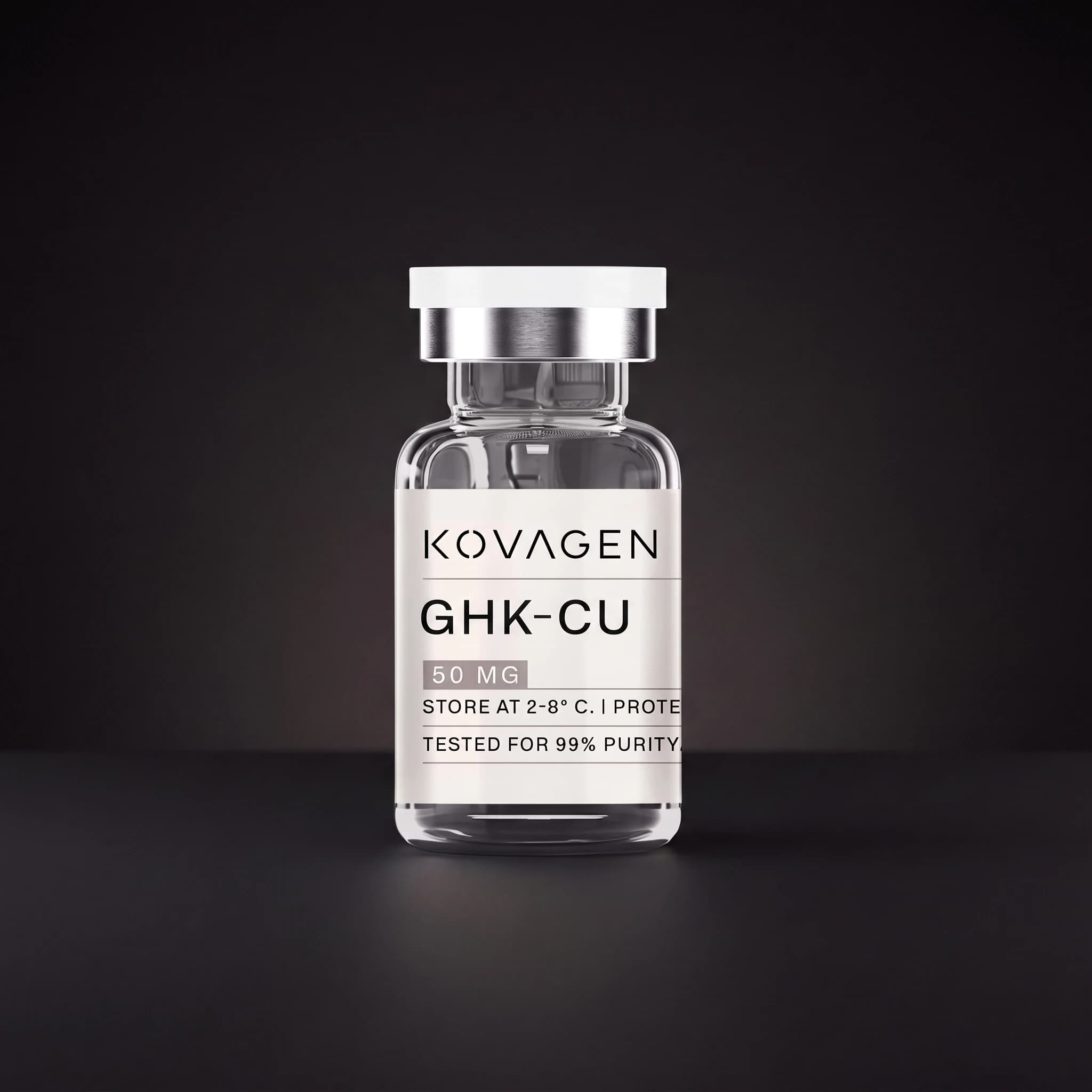
GHK-Cu is a copper tripeptide complex supplied for laboratory research. Its formula is published as C14H23CuN6O4+, with an average molecular weight of 402.92 g/mol. That species is already charged, so the ion a spectrum is compared against is the molecule itself at 402.1077 m/z rather than a protonated neutral. This page covers its structure, how it is produced, and how identity and purity are established — for a batch, on that batch's certificate of analysis.
What is GHK-Cu?
GHK-Cu is the tripeptide glycyl-L-histidyl-L-lysine in complex with a copper(II) ion. The peptide portion is three residues; the copper is coordinated to it rather than covalently bonded, held by the histidine imidazole and the peptide backbone nitrogen atoms.
The complex is characteristically blue in solution, which is a direct consequence of the coordinated copper — a visible property that no purely organic peptide in this catalogue has.
It is supplied at 50 mg and 100 mg, the largest fill weights in the catalogue.
How is GHK-Cu produced?
Assembled by solid-phase peptide synthesis: the chain is built one residue at a time on an insoluble resin support, then cleaved from the resin, deprotected and purified — most commonly by reversed-phase high-performance liquid chromatography. The purified material is lyophilized to a dry solid.
The impurity profile that appears on a certificate is a record of where that process was imperfect: deletion sequences from an incomplete coupling, truncated chains, and species retaining a protecting group.
What are the molecular figures for GHK-Cu?
GHK-Cu is published with the formula C14H23CuN6O4+. The monoisotopic mass and expected [M+H]⁺ are not stated here, because this is not a neutral single molecule: the metal ion is coordinated to the peptide and the species is itself charged, so a neutral-molecule ion has nothing to attach to.
What a mass spectrometer is compared against for a species like this is the ion itself, at the exact mass of the published formula. The identity result and the method stated on a batch certificate are what establish the material in a specific vial, and a certificate for this compound is read the same way as any other — per parameter, against a stated specification.
What is the sequence of GHK-Cu?
No one-letter amino-acid sequence is published for GHK-Cu on this page. The supplied material is a copper(II) complex. Its peptide component is Gly-His-Lys, but the structure the record describes — and the structure the formula above belongs to — is the complex, which no peptide notation can express.
What establishes the material in a specific vial is the identity method and result stated on that batch's certificate, not a notation on a reference page.
How does GHK-Cu compare with related compounds?
Related compounds are not interchangeable. Published figures differ between them, and in this catalogue three compounds share a GHRH backbone while several share the same structural class — which is exactly why identity is confirmed analytically rather than inferred from the label.
How is the identity of GHK-Cu confirmed?
Identity here has two parts rather than one, which is unusual in this catalogue. Mass spectrometry confirms the tripeptide sequence, and the copper content confirms the complex actually formed at the intended stoichiometry.
A vial containing the correct tripeptide but insufficient copper is not GHK-Cu — it is GHK. That distinction is invisible to a peptide purity measurement and requires elemental analysis to detect.
Which impurities can appear in GHK-Cu?
Copper is a specification to be met here, not an impurity to be minimised. This inverts how a heavy-metal result on a certificate should be read: for every other compound in the catalogue, copper would be a contaminant, and for this one a copper figure below specification is a failure of the material.
The complexed metal also complicates chromatography. Copper can interact with the stationary phase and with residual metal in the instrument path, so a method for GHK-Cu has to account for the complex remaining intact — or deliberately not — through the separation.
As a tripeptide it is small and polar, so it is weakly retained under reversed-phase conditions for the same reasons KPV is.
What does a certificate of analysis for GHK-Cu report?
A certificate for a batch of this material names the batch, names the issuing laboratory, and states for each parameter both the method used and the specification the result was measured against. Identity and purity are the two core results; net peptide content states how much of the fill weight is actually peptide.
A certificate belongs to a batch, not to a product line. When a new batch is released it is tested again, and the certificate published against it is that batch's certificate — a previous batch's result is never carried forward.
Is GHK-Cu for human use?
No. This page describes structure and analysis. It makes no claim about what this compound does, and none should be inferred from it. Material is supplied for laboratory research use only: it is not a drug, food, dietary supplement, cosmetic or medical device, it is not for human or veterinary consumption, and no dosing, administration or reconstitution guidance is provided for any such use.
References
- Prezatide copper (GHK-Cu) — PubChem, National Library of Medicine
- Collagen alpha-1(I) chain — human — UniProt Knowledgebase
- One-Pot Synthesis-Biocompatible Copper-Tripeptide Complex as a Nanocatalytic Medicine — Advanced Science, 2021
From the catalog
Compounds referenced on this page
In stock
Blends
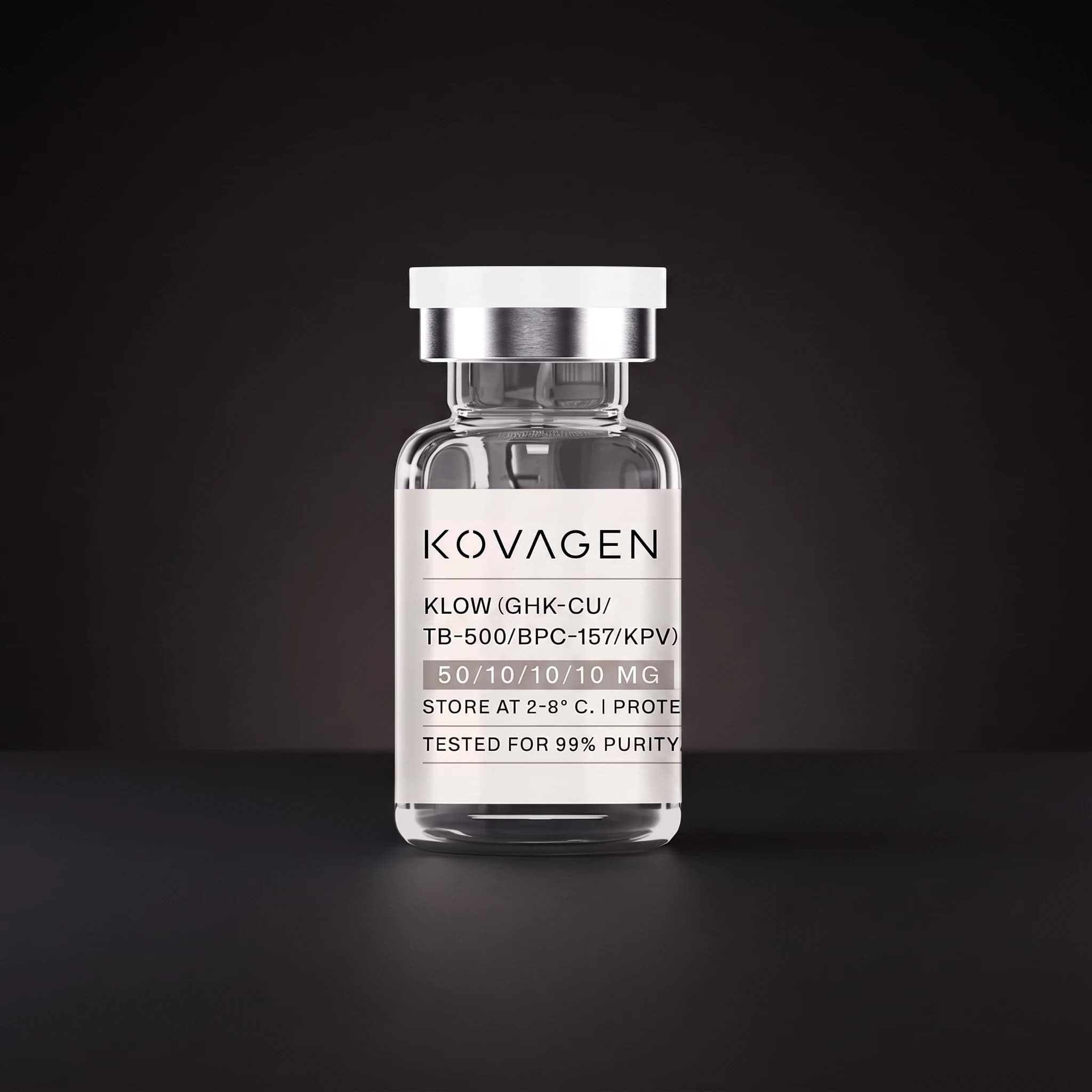
Klow (GHK-Cu / TB-500 / BPC-157 / KPV) 50/10/10/10
50/10/10/10mg
For laboratory research use only. Not for human or veterinary consumption.